
Fairfield Previous Residents by Era
One Fairfield address can cross several record systems as the years go back. Begin with the current parcel and deed trail. Then shift to the historical index books, regional directories, released census schedules, and local-history holdings that fit the period. The table separates the documented coverage from the information each source can contribute. A source can identify a transfer or an address listing without proving the full household at every point in time.
| Source | Years It Covers | Where Held | What It Shows |
|---|---|---|---|
| Recorder legacy record search | 1987-present systematic index/image statement | Butler County Recorder | Modern recorded-document chain and book/page access. |
| Recorder alphabetical and Red Book indices | 1797-1876; 1978-1987; Red Books 1803-1876 | Butler County Recorder historic search | Grantor and grantee paths before the standard electronic era. |
| Hamilton digitized directories | Identified volumes 1858-59 through annual 1961-75, with gaps | Cincinnati and Hamilton County Public Library | Address and household clues in a regional directory corpus. |
| Reverse or householder directory evidence | 1975 sample inspected | Regional directory collection | Street, number, occupant, phone, and occasional vacancy or no-return notation. |
| Federal census schedules | Released 72 years after the census date | National Archives, library, and genealogy access | A dated household snapshot to compare with nearby directories. |
| City permits or code material | No verified online year range | Fairfield Building and Zoning or public-records request | A dated project, inspection, or city record if an identifiable record is held. |
For a recent transfer, start with the Auditor parcel card and Recorder document index. For an older household question, pair the property trail with regional directories, local newspapers, atlases, and a released census schedule. The Butler County Auditor parcel-card navigator is the current starting point for the property side of that process.
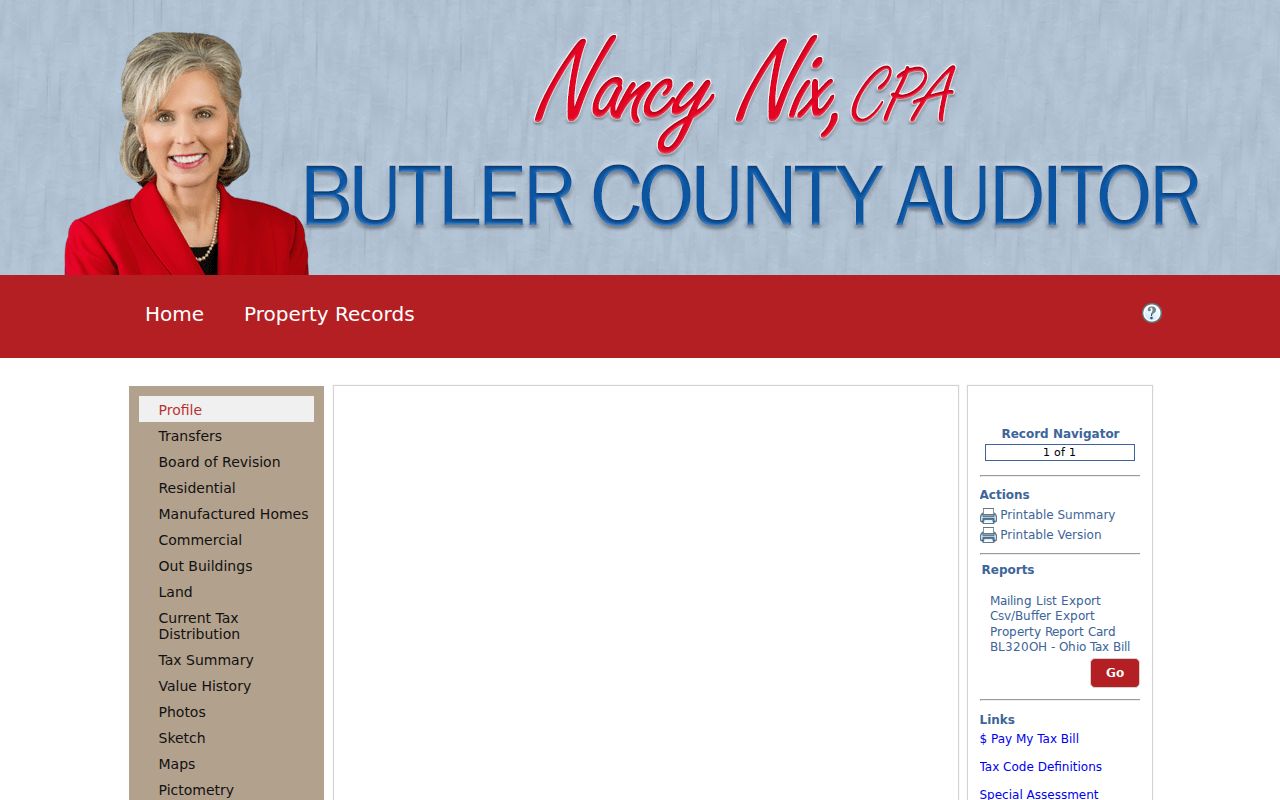
The parcel card can supply the PIN, situs, legal description, current owner, mailing fields, transfers, and values that distinguish one address from another before older names are searched.
Fairfield Address Timeline From PIN
The PIN is the best anchor for a backward address trail because street wording can change and a parcel can carry a legal lot or subdivision description. On the Auditor record, copy the PIN, legal description, situs or LOCATION, current owner, mailing address, transfer or sale details, and subdivision or lot reference. Preserve spellings exactly. A mailing address is an owner correspondence field; it can differ from the physical situs without indicating an error.
Present title and past occupancy are separate questions. The tax owner can be an individual, trust, estate, company, or co-owner. It is not a household list. A historical directory entry can place an individual or household at an address for its publication year, but it does not establish title. Keeping the property facts, deed dates, and directory dates in one timeline makes these distinctions visible instead of letting a same-name result drive the conclusion.
Fairfield Deed Index Eras
The Recorder’s modern and historical tools meet at the same address question but do not have one uniform earliest name-index date. Its legacy Real Estate information describes standard documents as indexed and imaged from 1987 forward. Separately, the Recorder reports that its imaging project is complete and that deed, mortgage, miscellaneous, release, lease, power-of-attorney, and partnership books are available by book and page. Read those statements together rather than assuming every early record can be found by a modern surname search.
The Recorder’s office information and official search access is the source for its copying and document routes. The office says it will try to accommodate an unavailable online index or copy by email, fax, or mail. Counter service is another channel. For the earliest periods, the Records Center and Archives is the historical fallback when the needed material is outside the digital trail.
The Recorder is the custodian for recorded title documents. Its documents, images, and historic indices are stronger evidence of a conveyance than a name-only address match.
Trace Fairfield Previous Owners
To move backward, turn the current buyer into yesterday’s seller. Search the current owner as a grantee in the Recorder’s official search, narrow by the approximate transfer date and a deed-related document type, then open the acquisition document. Record the grantor, legal description, recorded date, document number, and book/page. Search that grantor as a grantee for the earlier acquisition, then compare the legal description, PIN, or subdivision rather than relying only on the street address.
- Open the Auditor parcel card and write down the PIN, legal description, situs, current owner, transfer data, and subdivision or lot details.
- Search the current owner as a Recorder grantee and locate the acquisition document that fits the approximate transfer date and property description.
- Record the grantor, then search that party as a grantee for the earlier acquisition. Check the legal description or parcel relationship at every handoff.
- Repeat the grantee-to-grantor handoff, noting estates, trusts, corporate owners, splits, and mergers that can interrupt an apparent name sequence.
- When the modern result trail ends, change index systems rather than stopping. Use historic alphabetical, geographic, other-index, or book/page routes that fit the era.
- Grantor and grantee
- A grantor conveys an interest. A grantee receives it. In a purchase deed, the seller is commonly the grantor and the buyer the grantee.
- Chain of title
- The sequence of recorded transfers connected to the same property. Each link needs a legal-description or parcel match.
- Legal description
- The formal land description in the records, often using a lot, block, subdivision, township, or range reference. It can outlast a changing street label.
Fairfield Red Books and Geography
Older Butler title research has more than one bridge. The Recorder’s alphabetical deed index covers 1797-1876 and 1978-1987. Its Red Books cover 1803-1876 and are arranged by last-name initial with separate grantor and grantee parts. When a name path is weak, the Geographic Index can be searched by city, township, village, subdivision, condominium, or lot/range information. Other Index Books add routes for leases, miscellaneous records, powers of attorney, and cemetery deeds.
This variety is useful for a Fairfield address that predates the city name. Before modern incorporation, records may use Fairfield Township, Hamilton, or a former hamlet name. Keep cross streets, lot references, and printed spellings beside the street address. No verified citywide renumbering or renaming year was found, so one should not invent an address conversion. The historic index books and book/page images provide the documented fallback instead.
Fairfield Previous Resident Households
Deeds describe property rights, not every person who lived at an address. For the household layer, use a nearby regional directory issue and then a released census schedule. Hamilton’s digitized directory corpus includes identified volumes from 1858-59 through annual 1961-75, with gaps. A sampled 1973 page marks Fairfield addresses with “(F),” and a 1975 reverse-directory sample contains street, number, occupant, phone, and occasional vacancy or no-return status. These are period clues, not current findings.
- Choose a directory year close to the deed period and record the exact address spelling, name form, and any residence notation.
- Compare the entry with a released census nearest that period, keeping the census date separate from the directory’s publication year.
- Check the property’s legal description, cross street, and map context before treating similar addresses as the same place.
- Use an obituary, probate file, or newspaper notice only as a dated supporting clue, then return to the custodian for official court or vital material.
Lane Libraries accepts Property History, Obituary/Newspaper, Genealogy, Local History, Photograph, and Military research requests. The Randall Research Center of the Butler County Historical Society lists building histories, directories, newspapers, atlases, and court/legal documents. The directory holdings themselves are described in greater detail on the Fairfield city directory page.
Fairfield 1958 Atlas Bridge
Fairfield formed as a village in 1954 and became a city in 1955. That change is a useful boundary in an address history, because earlier evidence may be catalogued under Fairfield Township, Hamilton, Butler County, or a former hamlet. MidPointe Digital Archives holds Butler County atlases for 1836, 1855, 1868, 1875, 1895, 1914, 1925, 1930, and 1958. The 1958 atlas sits immediately after the city’s formation and can help place roads, lots, and early city geography beside a deed or directory date.
The City’s History of Fairfield records the incorporation and development context for that shift.
An atlas is historical cartography, not a legal survey. Use it to test geography and vocabulary, then confirm property rights through the legal description and Recorder record.
Fairfield Probate and Record Fallbacks
A prior-resident trail can end with an estate, obituary, cemetery clue, or a record that has not been digitized. Butler County Probate Court handles estates, wills, guardianships, trusts, and marriage licensing. Its public case information has a posting-delay warning, so a user who needs verification should request it or visit. A public estate record can identify a fiduciary or court-notice relationship where available, but it does not supply a blanket current-address answer for relatives.
The Butler County Probate Court provides the court route for estate and related matters.
For older court, probate, vital, naturalization, tax, and related books, the Butler County Records Center and Archives is the historic fallback. Local history staff at Lane and the Historical Society can also help identify a directory, map, obituary, or property-history source when electronic searching ends.
The 1912 courthouse tower fire and the 1913 flood do not prove a local record loss. The official courthouse history says the courthouse survived. Follow the appropriate custodian or Records Center route rather than assuming a missing result was destroyed.
Lawful house-history use. Researching past Fairfield households can support family history, estate work, and personal property history. Do not use a record trail to stalk, harass, or harm a living person; preserve protected information and verify important facts with the office that holds the record.